Competence-oriented learning integrates knowledge, skills, and attitudes, essential for effective performance in water sports contexts. This holistic approach emphasizes not just what learners know, but their ability to apply, reflect, and continuously develop these competences.
Grounded in meaningful, multidisciplinary, cooperative, and discovery-based methods, it supports personalized learning experiences that foster sustainability awareness and adaptive expertise. Validation extends beyond formal certification by recognizing diverse learning outcomes acquired in various settings, promoting lifelong learning and professional growth.
By embedding competence-oriented learning and validation, the Sustain-a-Wave project empowers adult educators and water sport professionals to drive impactful, context-sensitive sustainability education.
Introduction
Chapter
What it means for
Activities
Resources
The topic “Competence Oriented Learning and Validation” focuses on an educational approach that integrates knowledge, skills, and attitudes to ensure effective performance—particularly within the context of water sports education and Environmental Sustainable Development (ESD). It emphasises a holistic understanding of competences, viewing them not merely as knowledge acquisition but as the ability to apply, reflect, and continuously develop one’s capabilities in meaningful, contextualised settings.
This approach fosters learning experiences that are human-centered, multidisciplinary, cooperative, discovery-oriented, and reflective, encouraging learners to construct personal knowledge and connect it to factual challenges, including sustainability in water sports environments. Furthermore, it highlights the importance of validation mechanisms that recognise diverse skills and learning outcomes beyond formal certification, making lifelong learning visible and valued.
Learning Objectives
By the end of this learning unit, trainers will be able to:
Define competence as a holistic synthesis of knowledge, skills, and attitudes essential for effective performance in real-life water sports contexts.
Explain the principles of competence-oriented learning, including meaningful contexts, multidisciplinary approaches, constructive learning, cooperative and discovery-based methods, reflective practice, and personalised learning pathways.
Understand the process and importance of validation: identification, documentation, assessment, and certification of competences to better capture and recognize learners’ diverse knowledge and skills.
Promote Environmental Sustainable Development (ESD) through competence-based education that encourages responsible behaviour, resource optimisation, and active engagement with sustainability challenges in aquatic environments.
Competences as defined by various European bodies, as well as by educational experts throughout and beyond Europe, consist of three interrelated ingredients:
Knowledge (cognition),
Skills (capabilities and the overt behavioural repertoire)
Attitudes (emotions and values).
Knowledge and cognition are needed to understand the content matter, theories, principles, functionalities and own behaviour. Skills refer to the ability to apply knowledge effectively through observable actions and behaviours in diverse contexts. The affective dimension is vital since learning is always connected to emotions and values which bring in curiosity, motivation and commitment to learn and develop more.
Competences consist of a combination of cognitive, behavioural and affective elements required for effective performance of a task or activity. A competence is defined as the holistic synthesis of these components. If we see it this way it may be explained as the (inner) potential of a person to tackle a task. From another (an external) perspective a competence may again be divided in three aspects. A competent person is able to:
demonstrate behaviour
in a specific context and
at an adequate level of quality
What matters is not only what we know about things, but more importantly it is what we are able to do with this knowledge, and whether we are able to go on developing our abilities.
The development of competences is a very complex matter and is certainly not always a linear process. Competence development is a process which is highly dependent on the competence itself, the potentials (stages) of the learners and also on the external factors such as context and quality expectations.
Competence based learning and competence-based education do not consist of traditional teaching situations. They are based on the idea that the learners learn by experience and discovery. This concept has an impact on how learners may be educated. The idea is that learners need to be actively involved in the learning situation. They learn best in meaningful contexts and in co-operation and interaction with others and with their environment. Thus, they enable themselves to acquire knowledge, construe knowledge and check and cross check their newly constructed ideas with those of others.
Competence based learning requires an approach to education that differs from the traditional approaches to teaching. In competence-based education one tends to stress the importance of powerful, or rich learning environments, that enable students/learners to engage in meaningful learning processes. The most distinctive features of this approach may be summarised as follows:
Meaningful contexts – Experience the relevance and the meaning of the competences in a natural way. Example: Learners engage in water safety training at a local river or coastal area, experiencing firsthand the relevance of competences like reading currents or identifying hazards.
Multidisciplinary approach – Competences are holistic and consequently the educative approach needs to be integrative. Example: Water sport education integrates physiology (understanding the body in water), physics (buoyancy and waves), environmental science (water ecosystems), and social skills (team coordination).
Constructive learning – Learning is conceived as a process of constructing one’s own knowledge in interaction with one’s environment, rather than as a process of absorbing the knowledge others try to transfer to you. Example: Rather than just receiving swimming instructions, learners construct knowledge by experimenting with different flotation techniques, finding what works for their body and conditions.
Cooperative, interactive learning – To help learners to develop and construct their own knowledge and seek ways to make optimal use of other people’s competence in their learning itinerary. Example: Learners collaborate to maneuver boats safely, requiring clear communication, trust, and shared responsibility.
Discovery learning – The way of acquiring this knowledge or these competences, should not be just a process of providing information, but should always be embedded in a discovery-based approach. Example: In a discovery-based ESD project, learners might explore the impact of microplastics in lakes by collecting samples and interpreting results.
Reflective learning – By reflecting on one’s own needs, motivation, approach, progress, results etc. one develops learning competences/strategies that may be considered meta-competences. Example: Reflecting on personal water use habits or conservation choices encourages sustainable behavior.
Personal(ised) learning – Learners need to be able to identify with the contexts, the persons, the situations and interests that are included in the learning domains involved. Example: Learners choose projects matching their interests and goals allowing identity and motivation to guide learning.
These principles and features should be considered when designing, planning and delivering a learning module or learning pathway.
Validation is often reduced to certification, connected only to the delivery of proofs of attendance or considered as a rather formal exercise to deliver some kind of proof that learners crossed a certain threshold for whatever reason and for whichever purpose.
It has to be emphasised though, that the validation of competences can be far more than just another (isolated) assessment and certification exercise. It is also a great opportunity to invent new forms of learning and to improve teaching, training and learning design.
Validation is the process of identifying, assessing and recognising a wider range of skills and competences which people develop through their lives and in different contexts.
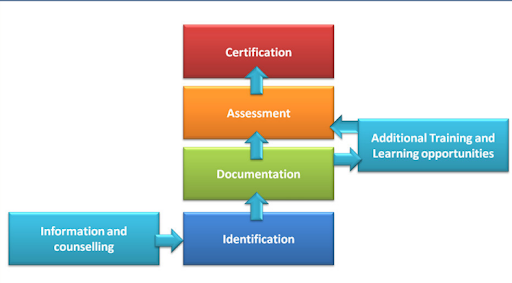
4 steps of validation:
The four step of validationIdentification – The collection and identification of existing competences and learning outcomes of the individual.
Documentation – The competence proofs and learning outcomes are collected in appropriate tools, for instance in e-portfolios.
Assessment – The existing evidence of competences and learning outcomes are classified according to specific reference points and / or standards.
Certification – Seeks to ’authorise’ a person to perform certain activities by awarding a formal qualification (or partial qualification, or ‘license’).
The purpose of validation is to make visible the full range of a person’s knowledge and experience, regardless of the context in which the learning originally took place.
Competences are something dynamic and develop during learning. In order to be able to measure and document the different levels of competence, reference aspects are consulted for operationalisation. Taxonomies are such reference systems. Besides well-known taxonomies such as Bloom’s or the EQF (European Qualification Framework), there is also the LEVEL5 taxonomy. Bloom’s taxonomy focuses more on “learning”, whereas the LEVEL5 taxonomy “consists of Knowledge, Skills (capabilities) and Attitudes (emotions/values) on 5 levels. This taxonomy facilitates assessing, documenting but also planning competence developments in highly context-dependent environments such as learning in mobility or learning on the job or in leisure time activities.
LEVEL5 Reference System
Adult Education Sectors
For adult educators, the key topic is applying competence-oriented learning and validation methodologies to design, deliver, and assess sustainability-focused education using water sports as an innovative learning space. Emphasizing personalized, reflective, and cooperative learning strategies supports transformative education that links theory and practice in meaningful contexts relevant to Environmental Sustainable Development (ESD).
Potential Applications with practical examples
Developing competence-based curricula and learning pathways that integrate cognitive, behavioral, and affective components tailored to adult learners’ needs in water sports and sustainability.
Facilitating interactive workshops and experiential activities that promote discovery learning about ecological impacts and stewardship within water sport settings.
Implementing validation processes such as e-portfolios to document learners’ progress, recognize informal and non-formal learning outcomes, and support lifelong learning.
Encouraging reflective practice among learners and themselves as educators to continually improve teaching methods and environmental messaging.
Collaborating across disciplines to bring holistic sustainability perspectives into the educational offer, addressing physical, social, and ecological dimensions of water sports.
Water Sports Sector
For water sport professionals, the central topic is developing and validating practical competences that integrate technical water sport skills with environmental stewardship and sustainable practices. This includes mastering not only the physical and safety aspects of water activities but also understanding and applying sustainable resource use, ecological impact minimization, and participant awareness of environmental challenges. Competence here means combining knowledge, skills, and attitudes to perform effectively and responsibly in diverse aquatic environments.
Potential Applications with practical examples
Designing and leading competence-based water sport sessions that explicitly incorporate environmental education, such as teaching safe navigation around sensitive habitats or organizing clean-up paddleboarding events.
Applying competence validation tools like digital portfolios or reflective logs to track and recognize sustainable practices adopted in daily work and training.
Engaging in multidisciplinary collaboration with environmental experts to create innovative, sustainable water sport programs that foster responsible behavior and resource optimization.
Mentoring novice water sports participants in sustainable behaviors and competence development through cooperative and discovery-based learning approaches.
Eco-Responsible River Tour
For whom: Water Sport Professionals
Objective: Enable water sport professionals to integrate sustainability and competence validation into everyday instruction, reinforcing environmentally conscious behaviors during water activities.
Instructions:
Briefing: Begin with a short presentation about local aquatic ecosystems and common environmental threats (e.g., litter, invasive species). In the briefing also explain the correct implementation of the activity, which will be in accordance with safety rules.
Practical session: Organize a guided river tour (by paddle, kayak, small boat etc.) where the group completes a route mapped to highlight environmental hotspots. Each stop includes a mini-task:
Identify human impacts (e.g., trash collection, noting wildlife encounters).
Quick quizzes about best practices for minimizing disturbance and resource use.
Competence validation: Participants briefly document their observations, actions, and recommendations for future sessions in a reflective log or digital portfolio, focusing on knowledge (ecosystem understanding), skills (navigating with minimal impact), and attitudes (demonstrating stewardship).
Group review: Share findings and discuss most effective ways to incorporate sustainable practices into water sport routines.
Key outcomes:
Direct application of sustainable behaviors in a real-world sport context.
Practice in documenting and validating competence development.
Increased awareness of environmental responsibilities and communication skills with participants.
Sustainable Learning Pathways Workshop
For whom: Adult Educators
Objective: Empower adult educators to design and validate competence-based, sustainability-focused learning experiences for water sports participants.
Instructions:
Introduction: Open with an overview of competence-oriented learning, using water sports sustainability as the context.
Collaborative design: In small groups, educators select a water sport (e.g., windsurfing) and a sustainability theme (e.g., water quality). Each group creates a short “learning pathway” that links technical skill development with an ecological issue. Example steps: introducing the sport, embedding discussion/reflection tasks related to the sustainability theme, designing activities that require observation or intervention (such as a mini water quality test).
Validation plan: Each group develops criteria and simple tools (e.g., reflective prompts, observation checklists, peer feedback forms) to recognize and validate the competences acquired through the pathway.
Mock implementation: Groups present and role-play a segment of their pathway, receiving feedback from peers.
Key outcomes:
Practical experience in designing and assessing competence-based learning in the context of water sports and ESD.
Familiarity with validation tools and their integration into adult learning.
Enhanced confidence in facilitating transformative, sustainability-focused educational experiences.
Competence oriented learning and validation towards professionalisation and quality in informal, non-formal and formal learning van Lakerveld, J., Scholze, T., & Tilkin, G. (2019). PLATO, Leiden University, NL; University Duisburg-Essen, DE; blinc eG, REVEAL e.V, Göttingen, DE; Alden Biesen, BE. (https://reveal-eu.org/wp-content/uploads/2019/12/IO3_REVEAL_Learning_System.pdf)