- Summary
- Fact Sheet
- More Information
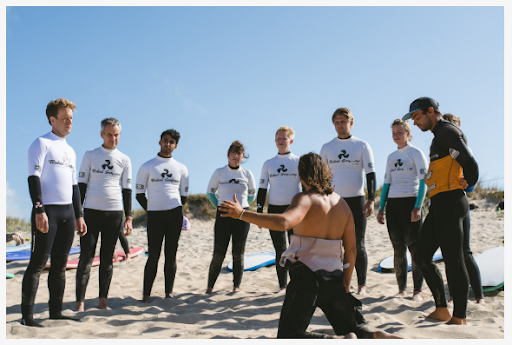
Several surf schools in Portugal actively integrate sustainability into their teaching philosophy, reflecting the strong cultural connection between surfing and ocean stewardship, in Peniche, Baleal but also along the ocean shore. The main sustainability objective is to develop environmentally responsible surfers who understand the importance of protecting coastal and marine environments.
Surf lessons are generally complemented with discussions on marine pollution, climate change and sustainable equipment choices and even beach clean-ups in some cases.
Key learning objectives:
Students learn through experience how their actions affect ocean health and coastal ecosystems. The learning objective is a positive behavioural change, cleaner beaches and stronger environmental awareness among young participants.
Importance of water sport:
Surfing strongly supports the objectives of Education for Sustainable Development (ESD) by creating a direct and continuous relationship between learners and the ocean. As a nature‑dependent sport, surfing makes participants immediately aware of ocean conditions, water quality, coastal dynamics and environmental degradation. This close connection transforms sustainability from a theoretical concept into a lived experience, fostering environmental awareness, responsibility and systems thinking, which are central to ESD.
The added value of connecting this project with surfing lies in its high engagement potential, particularly among young people. Surf schools provide accessible, non‑formal learning environments where sustainability messages can be integrated naturally into practice through beach clean‑ups, discussions on marine pollution, climate change and responsible behaviour. Surfing also strengthens emotional connection to the ocean, which is a key driver of long‑term behavioural change. By combining sport, education and community action, the project demonstrates how surfing can act as an effective catalyst for ocean literacy, active citizenship and sustainable coastal practices.
Target Groups/Clients:
Surf schools, instructors, students, families and local communities.
Good practices:
This project shows good practice by integrating sustainability and ocean literacy directly into surf activities, using surfing as a non‑formal learning environment. A key strength is the combination of sport practice with concrete actions such as beach clean‑ups, reflection on marine pollution and responsible coastal behaviour. Surf instructors act as facilitators of environmental awareness, ensuring continuity and long‑term impact, especially among young participants. Strong synergies are created between surf schools, local communities and environmental organisations. These practices are easily transferable to other water sports and outdoor education contexts and are worth promoting as low‑cost, high‑engagement approaches to fostering environmental responsibility, active citizenship and sustainable coastal lifestyles.
Event Website/Social Media:
Gallery